Security and governance

Your organization decides before the model does.

Feza runs the workspace, from chat to automation, on one security layer. Access scope and model route are set before each request runs. Only permitted content is processed, and the run is recorded.

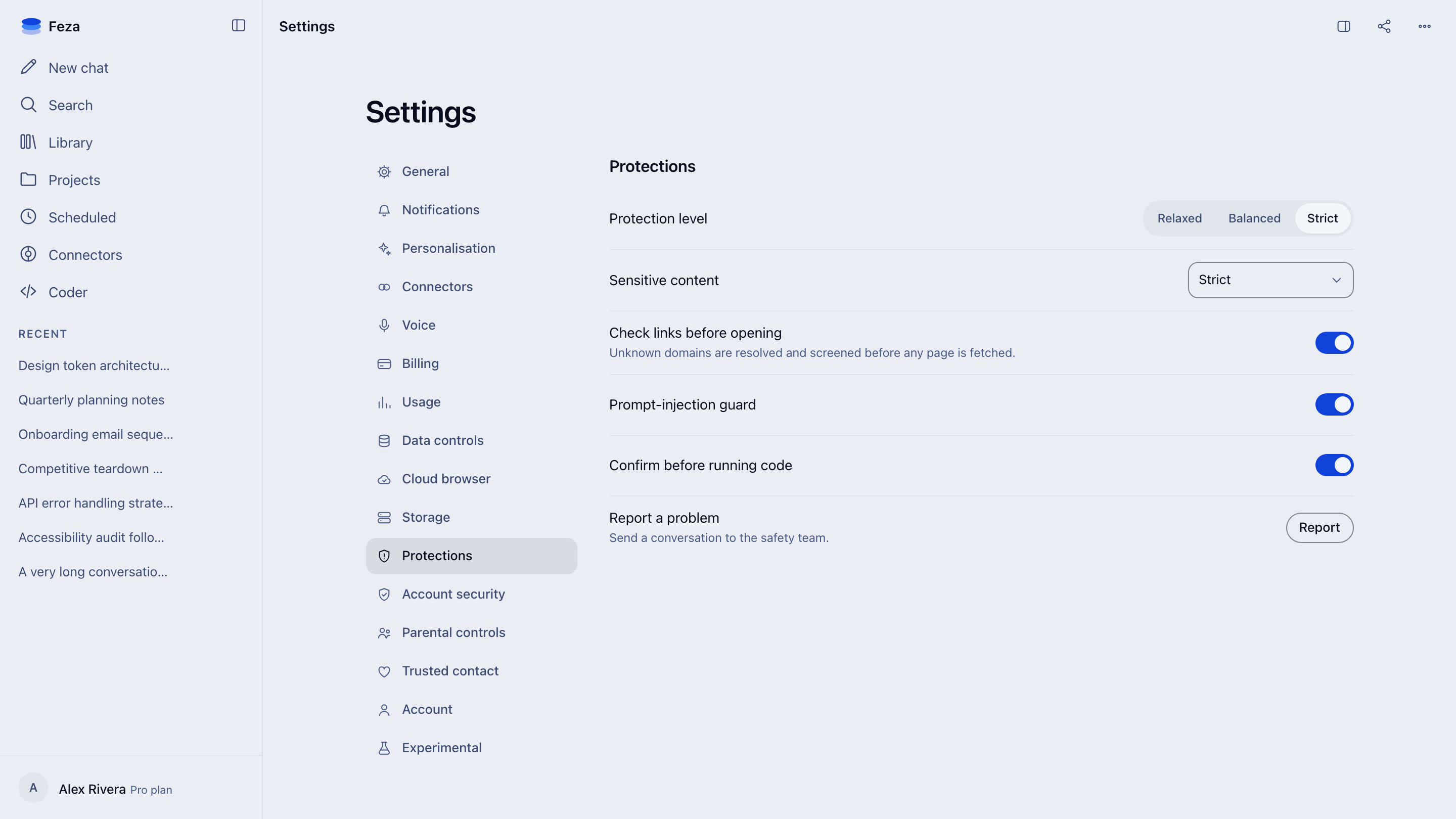
The Protections tab in Feza settings: protection level Strict, with the prompt-injection guard and link checking on

One workspace. One control layer.

Feza's security does not depend on a single model or provider. Even when the model changes, users, permissions, policies, and audit records stay under your organization's control.

Computed access

The scope of every request is computed from permissions before the model runs.

Sensitive data control

DLP checks sensitive data in the request and from connected sources against your organization's policies.

Model route

Requests can be sent to routes that stay entirely in the European Union, or to routes beyond it that your organization has approved.

Auditable operations

Every run is tied to a user, a model, a route, the policies applied, and the result.

How a request runs in Feza

1 · Access scope is computed

The user's permissions at the organization, team, project, object, and action level are evaluated before the request runs. The model is never asked to ignore information it should not reach: unauthorized information never enters the context the model receives.

2 · Data goes through DLP policies

What a user writes, the documents fetched, integration results, and automation inputs are all evaluated against sensitive data policies. Depending on the policy, that content:

  • Can be used as it is.
  • Can be processed with sensitive fields masked.
  • Can be sent only to an EU-hosted model route.
  • Can be blocked entirely.

3 · Sensitive fields are masked

Prompt masking ensures that personally or organizationally sensitive fields are masked before they reach the model. The model sees the context it needs to carry out the operation. It does not see the original values that policy requires to be protected.

4 · The model route is set

The model routes available are set by organization policy, data class, intended use, and processing boundary. The user is offered only the models and routes allowed for that request.

5 · Tool calls are re-authorized

A model choosing to call a tool does not mean it has the permission to carry that operation out. Every tool call is checked again on the server against user, service identity, object, and action permissions.

6 · The operation is recorded

Who ran it, which model and route it went through, and which data policies applied are all recorded. The records themselves fall under the same access and data protection rules as the chat, project, or automation they belong to.

Access is limited by the system, not by prompts.

Two independent enforcement layers
Access scope is enforced both in the database and in server-side tool authorization. One layer allowing something does not remove the other layer's check. Every endpoint checks the request again.
Out-of-scope information is not visible
An object a user cannot reach is not simply an object that will not open. For that request it is not treated as existing. A chat held by someone on the finance team cannot reach Human Resources data. The reason is not an instruction given to the model: the information never enters that request's scope.
The narrowest rule applies
Rules at the organization, team, project, object, and action level are evaluated together. Where they conflict, the narrower access rule is applied.
Team policies can only narrow
A team can narrow the access and data policies the organization defines. It cannot widen or weaken the organization's ceiling.
When a permission is removed, new access stops
Authorization is evaluated again on every new request. When a user's permission is removed, fetching new information stops from the next request onward. Records of operations that already happened are not changed retroactively.
Background jobs run under their own identity
Agents, scheduled jobs, and other background processes run under the service identities defined for them. They do not automatically inherit the wider access scope of the admin who created them.

DLP and prompt masking

Sensitive data is checked before the model
DLP checks are not applied only to the prompt a user writes. Documents fetched from connected data sources, integration outputs, agent contexts, and automation inputs pass through the same policies.
Organizations set their own sensitive data rules
Organizations can define which data types may be processed freely, which must be masked, and which may not be sent to particular model routes. These policies can be narrowed by team, project, intended use, and model route.
Prompt masking reduces data exposure
Prompt masking lets an operation continue without sending the original values of personal information, customer data, trade secrets, and other sensitive fields the organization has defined. Masking does not replace access control: the user must first have permission to reach the information, and then pass the data policies.
DLP stops the request when required
Not every use of sensitive data continues with masking. Organization policy can require that certain content is processed by no model at all, or used only on EU-hosted routes.
Records fall under the same protections
Masking content on the way to the model and then keeping it in the clear in the audit record is not accepted. Audit records, context, and results are held under the relevant access, DLP, and retention policies.

Where data is stored, where it is processed

Retention and inference are managed separately
Where workspace data is kept and where model inference happens are treated as separate boundaries in Feza. Feza is being built to keep workspace data in the European Union. Model inference can happen in the European Union, or on a route beyond it that the organization has approved, according to organization policy, data class, and the route chosen.
A route that stays entirely in the European Union
When EU-hosted models are used, both workspace data and model inference stay inside the European Union. This route is built for customers who do not want their data to leave the Union, who prefer local processing under organization policy, or who can process certain data classes in one jurisdiction only.
Approved cross-border route
For the data and use cases organization policy allows, inference can be carried out over an approved model route beyond the European Union. On this route workspace data stays in the European Union. Only the content permitted for that request, masked where required, is sent to the chosen model.
The same organization can use both routes
An organization does not have to pick one model route for all its requests. General internal content can be processed on an approved route beyond the Union while sensitive data is sent to EU-hosted models. Data classes that are barred are sent to no model at all.
The boundary is visible before sending
The model, provider, and processing region to be used are set before the request is sent. The route that actually ran is then added to the audit record. "Approved route" here means a route allowed under organization policy. It does not mean a certification from a regulatory body.
A claim to stay in the EU is verified end to end
A model server sitting inside the European Union is not on its own enough to say that inference stays there. No route is published as a "route that stays in the European Union" until the model infrastructure, the content sent, the audit records, and the related data flow have all been verified.

Model routes

A route is not just a model name
Every route is a durable Feza object defined by a model, a provider, a processing region, the data classes allowed, and the use policies in force.
The rules are independent of the provider
Organization policies are not built around the features of one model provider. Even when the model in use changes, the access, DLP, prompt masking, and record rules keep being applied.
No silent fallback
A request that has to stay in the European Union is not sent automatically to a model outside it when the local route is unavailable. In the same way, a route that does not meet the boundary the organization approved is not quietly swapped for another provider or region. The request stops and the situation is shown to the user.
No model is trained on customer content
Feza does not use customer content to train its own models. This is not a certification or a marketing badge. It is Feza's own commitment about how that content is used. The data use terms of external model providers are evaluated route by route and presented where the organization can see them.

Governance and admin controls

Roles and memberships are managed in one place
Users, team memberships, roles, access boundaries, and model policies are managed at the organization level.
The same rules hold across the workspace
Using chat, an agent, an automation, a project, a skill, or an integration does not change the security model. The same identity, access, DLP, and model route rules are applied across the whole Feza workspace.
Integrations do not gain unlimited access
An integration being connected does not mean every user can reach all the data in that system. Integration actions are limited by the scope of the user, the team, the project, and the service identity.
High-impact operations can be tied to approval
Human approval can be made mandatory for actions that change data, send to an external system, or produce a result for the organization. An agent proposing an operation is kept separate from the operation being carried out.
The records themselves are permissioned
An audit record is not opened to a wider audience than the chat, project, or automation it belongs to. What the record contains falls under the relevant masking and data retention policies.

Risks specific to AI

Prompt injection is treated as a default risk
Feza assumes the model can be steered by a document, an email, or web content it reads. Fetched content is labeled as data, not as instruction. The model carries no credentials. Every tool call is re-authorized on the server against the user's real access scope.
Prompt masking and prompt injection are not the same thing
Prompt masking reduces how much sensitive data is exposed to the model. Prompt injection controls are applied against fetched content steering the system or its tools. Feza treats the two risks as separate security layers.
A model cannot grant permission on its own
A model proposing an operation or producing a tool call does not create the permission to carry it out. Permission always comes from Feza's server-side identity and policy layer.

Current trust status

Feza publishes only the trust claims that can be verified.

Certification
No information security standard or certification is claimed. A certification will be published here only after its scope and validity have been verified.
Independent review
No completed third-party security review or penetration test is claimed for the product as it stands.
Regulatory compliance
No general or unconditional claim of compliance is made for any jurisdiction. An organization's data type, intended use, model route, provider, and contractual structure must be evaluated separately.
Availability
Without a measured and published service level in place, no availability rate or SLA is claimed.
File security
File type validation, quarantine, and malicious content scanning are among the launch conditions. Until these controls are verified, it will not be claimed that they are operational.
Performance and capacity
Without representative measurements in place, no figures for speed, volume, file size, accuracy, or language quality are published.

FAQ Short answers.

The information and tools a request can reach are computed from the user's memberships and permissions before the request runs. The scope is then enforced in the database and in server-side tool authorization.

DLP can check user inputs, fetched documents, integration results, agent contexts, and automation inputs. Which action is applied is set by the organization's data policy.

Prompt masking masks sensitive fields before the model call. The model gets the context it needs to carry out the operation without seeing the original values that have to be protected.

No. Organization policy can decide that data is masked, processed inside the European Union only, or sent to no model at all.

No. Information the user has no permission for is not taken into the context for that chat. The boundary rests on rules in the access and data layer, not on a system prompt.

Yes. When an EU-hosted model route verified end to end is used, both workspace data and the inference operation stay inside the European Union.

Yes. An organization can set different routes by team, project, intended use, or data class. Sensitive data can be processed inside the European Union while permitted content is sent to approved routes beyond it.

No. A request that has to stay in the European Union is not quietly sent to a model beyond it. The request stops and it is shown that the route is unavailable.

No. Feza does not use customer content to train its own models. The terms of external model providers are evaluated separately for the route in use.

Fetched content is labeled as data, the model carries no credentials, and every tool call is checked again on the server against the user's real permissions.

No. Agents and background jobs run with the service identity and access scope defined for them.

No. Feza provides technical and administrative controls. Regulatory compliance must be evaluated together with intended use, data type, the route chosen, contracts, and the organization's other obligations.

No certification is claimed at present. Certifications will be published on this page only after their scope and validity have been verified.

Yes. The planned use case, data classes, DLP policies, the access model, and model routes can be reviewed together.